


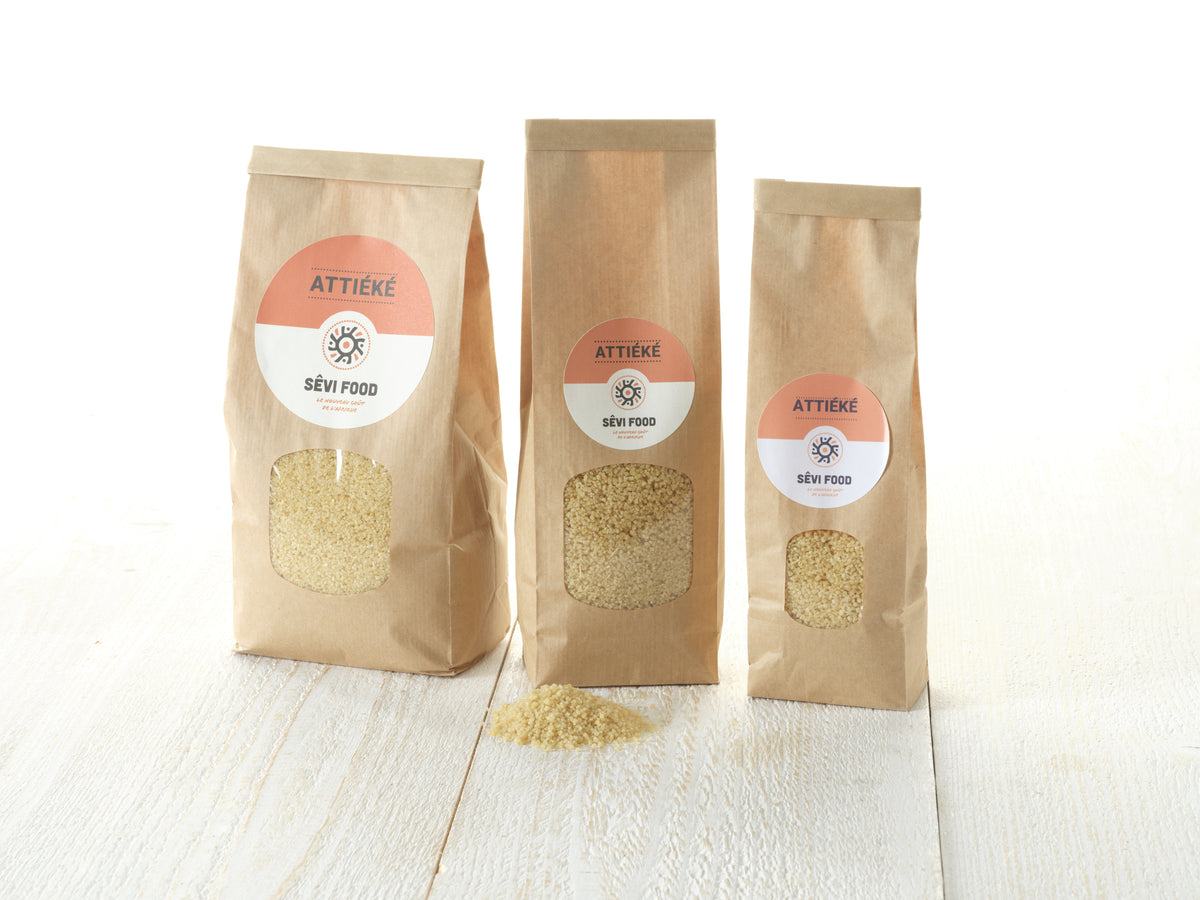
Attiéké – Fermented cassava couscous - 1kg
Attiéké is a traditional Ivorian specialty made from fermented cassava processed into small grains. SêviFood Attiéké is dehydrated for better preservation and rehydrates easily before cooking. Its texture and slightly tangy flavor make it a versatile acc…
Read more Show less
Attiéké is a traditional Ivorian specialty made from fermented cassava processed into small grains.
SêviFood Attiéké is dehydrated for better preservation and rehydrates easily before cooking. Its texture and slightly tangy flavor make it a versatile accompaniment to fish, meat, vegetables, and sauces.
Discover this Ivorian specialty and bring it into your kitchen.
Best before: see date on packaging.
Batch: indicated on the bag.
Net weight: 1,000 g
Couldn't load pickup availability
-


Ready to cook
-

GLUTEN-FREE


Ingredients
Nutritional values
Storage

PREPARATION INSTRUCTIONS
SêviFood dehydrated Attiéké must be rehydrated before cooking.
Steaming
Mix 100 g of Attiéké with 80 ml of water. Let stand for 5 minutes until the water is absorbed, then steam for 5 to 10 minutes.
Microwave
Mix 100 g of Attiéké with 100 ml of water. Let stand for 5 minutes until the water is absorbed, then microwave for 5 minutes.
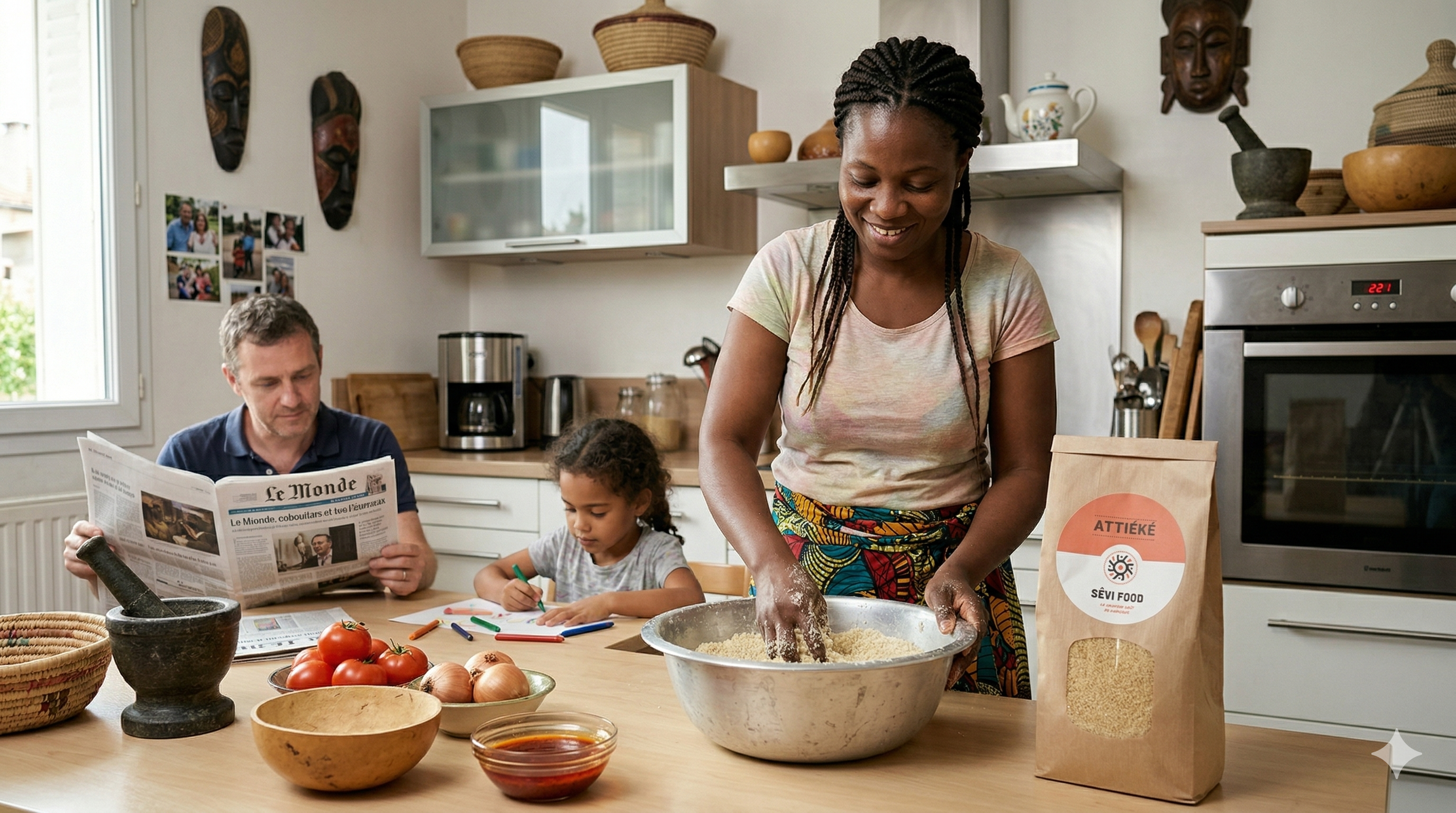
Attiéké is traditionally served with fish, meat, vegetables, and sauces. You can also combine it with your favorite ingredients and prepare it in your own way.
Important: our preparation tips have been updated following the evolution of our product. For optimal preparation, please follow the instructions indicated on this page.
Our recipe suggestions
Discover different ways to cook Attiéké and let yourself be inspired to create your own.


Attiéké
Attiéké is part of the culinary heritage of Côte d’Ivoire.
Stemming from expertise developed and passed down through generations, it holds an important place in dietary habits and moments of sharing.
Long rooted in the southern regions of Côte d’Ivoire, Attiéké has gradually spread throughout the country and well beyond its borders.
With SêviFood, this story continues: new tables are discovering Attiéké, making it their own, and imagining new ways to cook it in turn.

FROM CASSAVA TO ATTIÉKÉ
Expertise that requires time and patience.
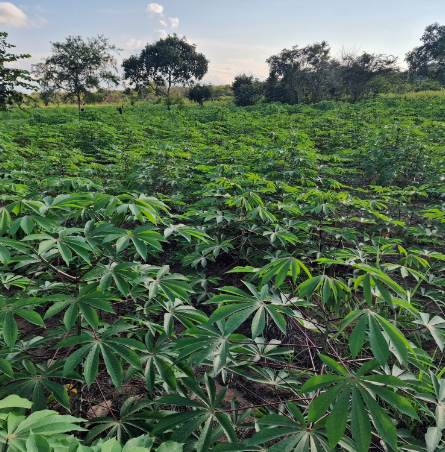
Our cassava is grown and harvested with care in villages in central and southern Côte d'Ivoire.
After harvesting, the roots go through several processing stages: peeling, cutting, washing, grinding, fermentation, pressing, sieving, granulating, and cooking.
At SêviFood, discovering a product also means understanding its origin and how it is made. Here are the main stages that give birth to Attiéké.
CASSAVA PREPARATION
1. Cassava root harvesting
Everything starts with the cassava roots. After harvesting, they are prepared for processing: they are notably peeled and washed before grinding.
2. CASSAVA GRINDING & ADDITION OF FERMENT
The prepared cassava is crushed to obtain a paste. A traditional cassava-based starter (called magnan) is used to initiate and facilitate the fermentation.

DOUGH PREPARATION
3. DOUGH fermentation
The cassava dough is left to ferment. This step plays an essential role in the development of the characteristics of Attiéké, particularly its slightly tangy taste.
4. Pressing the fermented dough
After fermentation, the dough is pressed to remove some of the water. This step makes it possible to obtain a material suitable for forming the grains.
5. Sieving
After pressing, the paste is crumbled and then sieved to obtain a more homogeneous material before the grains are formed.
SEMOLINA FORMATION AND COOKING
6. Granulation
The sifted material is worked to form the small grains characteristic of Attiéké. This step contributes directly to its semolina-like texture.
7. Drying, winnowing and sieving:
The grains are then dried and sorted by winnowing and sieving. This step notably helps prepare a uniform semolina for the rest of the process.
8. STEAM COOKING
The grains are steamed, a characteristic step in the traditional production of Attiéké. The cooking process provides the texture unique to Attiéké.
9. DEHYDRATION
Reducing its water content makes it easier to store while maintaining its semolina form.
It then only needs to be rehydrated before cooking to prepare it at home.
